Module 2 – Fire Chemistry
What is Fire?
Fire is a by-product of combustion, and combustion is a result of rapid oxidation.
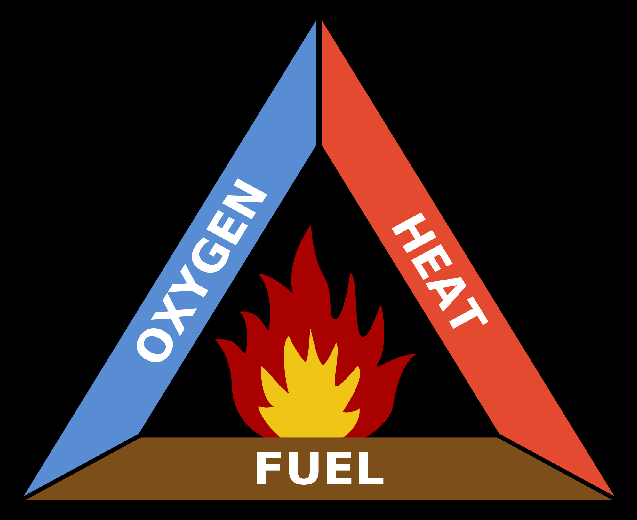
Triangle of Fire
Fuel Removed “Starving”
Oxygen Removed “Smothering”
Heat Removed “Cooling”
Fire Triangle
Fuel can be solid, liquid or gas. Only gases burn. The heat turns solids and liquids into gas.
Oxygen in the air, and oxygen in other materials, drives the process of oxidation.
The normal percentage of oxygen in the atmosphere is 21%. If the oxygen level drops to 15% or below, then it will not support combustion.
A spark or flame is all it takes. It can be a self-heating or chemical heat. The heat causes the vaporisation.
Ignition Sources
Electric current
Naked flames
Sunlight (solar)
Sparks
Chemicals friction (mechanical)
Nuclear static electricity
Hot surface
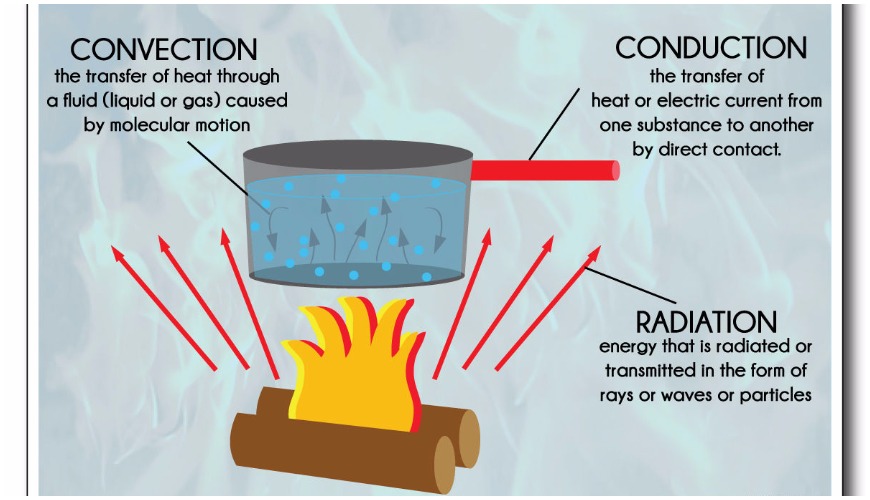
Conduction – The Spread of Fire
Direct Contact
Fire can spread by pipes connecting different areas
Convection - The Spread of Fire
Heat transferred by movement of air or liquid
Fire spreads up buildings by heated air
Radiation - The Spread of Fire
Infrared
Can travel across open spaces
Creates self-sustaining fire
Sources of Ignition
Chemical – Reaction giving off heat i.e. hay, oily rags
Electrical – Short circuit, overload circuit, static, heaters
Mechanical – Mechanical breaks, drive belt rubbing off a guard
Fuel
Substances which can provide the “FUEL” for Fire / Explosion
Flammable gases
Flammable liquids
Flammable solids
Spontaneously combustible substances
“Dangerous when wet” substances
Organic peroxide
Flammable Liquids
Broadly divided into two categories:
Liquids fuels – Most derived from petroleum e.g. petrol, kerosene
Solvents and raw materials – Used in the manufacture of other chemicals. e.g. methanol, ethanol, acetone and toluene
Definitions
Flash point – Temperature at which a liquid gives off sufficient vapour to flash momentarily when ignited by a flame or spark
Fire point – When liquid is heated past it’s flash point, it will reach a temperature where sufficient vapour is given off to maintain combustion
Ignition temperature – The temperature at which the molecules of a substance are able to combine with the oxygen molecules in the air
Sources of Heat
Cookers
Heaters
Fireplace
Damaged wiring
Sources of Fuel
Flammable liquids
Clothing
Furniture
Curtains
People
Development of a Fire
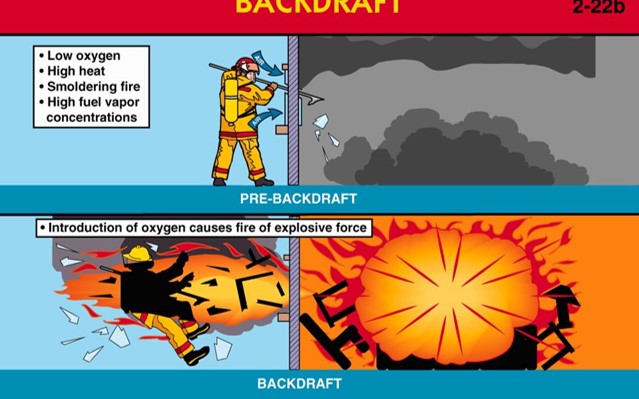
Backdraft - Introduction of Oxygen
Fire Safety
Fire safety is based upon the principle of keeping fuel and ignition sources apart.
HUMAN CARELESSNESS IS A MAJOR CAUSE OF FIRE!
Back to